In industrial heating systems, a self-operated temperature control valve is an automatic temperature-regulating device used to control the output temperature of thermal energy. It requires no external power or air supply, operating instead based on temperature-induced changes within the medium itself. These valves are widely used in applications such as chemical reaction vessels and steam piping networks; compared to traditional temperature control equipment, they are easier to install and have lower maintenance costs.
This article provides a detailed overview of self-operated temperature control valves, covering their components, temperature regulation mechanism, and key advantages.
Components of a Self-Operated Temperature Control Valve
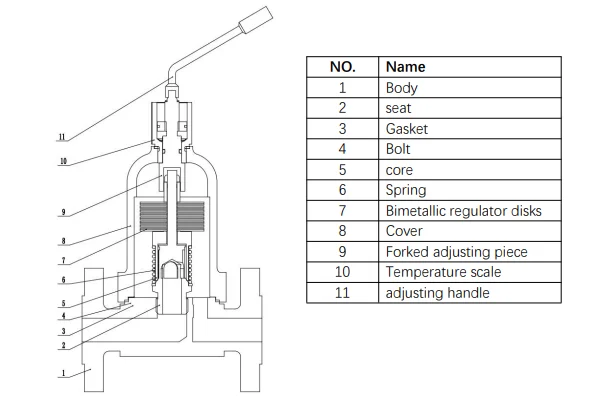
- Valve Body: Available in materials such as cast iron, cast steel, or stainless steel to suit various pressure levels and operating media.
- Valve Seat: Determines the valve’s sealing performance when closed and directly influences the rate of internal leakage.
- Gasket: Installed between mating surfaces—such as those between the valve body, bonnet, and actuator—to prevent external leakage and enhance overall sealing reliability.
- Bolts: Ensure uniform clamping force across mating surfaces and withstand the operating pressure of the medium, preventing structural loosening or leakage during operation.
- Core: Adjusts the flow area relative to the valve seat, allowing for precise control of the thermal medium’s flow rate and enabling proportional, continuous temperature regulation.
- Spring: Balances the thrust generated by the expansion of the temperature-sensing medium; as the temperature drops, it pushes the valve plug back to its original position, facilitating proportional, continuous adjustment of the valve opening.
- Bimetallic Regulator Disks: Utilizes the differential thermal expansion and contraction of bimetallic strips to compensate for the impact of ambient temperature fluctuations on the actuator’s internal signals, preventing set-point drift and improving temperature control accuracy.
- Cover: Encloses the internal cavity of the valve body/actuator, provides structural support for moving parts like the valve stem and piston, and prevents external contaminants from entering the internal mechanism.
- Forked Adjusting Piece: Converts the rotational motion of the control handle into a linear adjustment of the spring’s preload, allowing for precise fine-tuning of the target temperature.
- Temperature Scale: Provides a clear, visual indication of the target temperature corresponding to the current position of the control handle.
- Adjustment Handle: A manual, on-site control component. By rotating the handle, the pre-compression of the internal spring is altered, allowing for the adjustment of the temperature control setpoint. Temperature settings can be easily configured without the need for specialized tools.
How to Adjust the Temperature
The core operating principle of a self-acting temperature control valve relies on the physical properties of a temperature-sensitive fluid—specifically its thermal expansion and contraction, combined with the fact that liquids are incompressible. The system requires no external power or air supply; it operates autonomously by utilizing the energy of the medium being controlled, achieving a proportional temperature control accuracy of ±2°C.
As the fluid temperature drops, the flow rate through the valve increases. Fluid flow occurs only when the temperature falls below the designated “shut-off temperature” (i.e., the setpoint). This mechanism ensures sufficient fluid flow to maintain constant pressure and temperature, while minimizing heat loss and enhancing thermal energy efficiency.
The “shut-off temperature” is factory-preset, but users can adjust it within a specific range on-site to suit their operational requirements.
When the fluid temperature decreases, the valve’s internal flow passage opens, allowing a greater volume of fluid to pass through. Conversely, when the fluid temperature rises, the adjustment mechanism restricts the flow passage, thereby reducing the flow rate.
Advantages of Self-Acting Temperature Control Valves
Stable Operation Under Extreme Conditions
These valves operate entirely independently of external energy sources such as electricity or compressed air, relying solely on the physical expansion and contraction of the temperature-sensitive medium. They provide long-term, stable performance in demanding environments—such as explosion-proof chemical zones, remote heat exchange stations lacking power, or industrial workshops with high electromagnetic interference. Even in the event of a total power failure, the valve continues to provide basic temperature regulation, preventing safety risks associated with uncontrolled temperature fluctuations.
Quick and Convenient Installation
The valve body, temperature-sensing bulb, and actuator are integrated into a single, unified unit. There is no need for additional temperature controllers, power modules, or signal cabling, nor is there any requirement for complex system programming or commissioning.
Low Maintenance Costs
The typical maintenance interval exceeds 2–3 years. Routine upkeep is minimal, requiring only the periodic removal of debris or welding residue from the inlet strainer. There is no need for scheduled inspections or calibrations by professional electrical personnel, nor will you encounter common electronic control valve issues such as sensor drift or signal loss. This significantly reduces the labor required for operation and maintenance, making it an ideal solution for unattended, distributed heating sites.
Wide Range of Applications
The valve body can be manufactured from cast iron, cast steel, or stainless steel to suit specific requirements. It is compatible with various media—including water, steam, and thermal oil—and operates across a temperature range of -25°C to 350°C, ensuring stable performance even in harsh industrial environments characterized by high temperatures, high humidity, or intense vibration.
By simply swapping the valve core configuration, the unit can be flexibly switched between heating and cooling modes. It is well-suited for a variety of applications, including terminal radiators, domestic hot water systems, and temperature control for small-scale chemical reactors.
Conclusion
Self-operated temperature control valves ensure adequate fluid flow, maintain constant pressure and temperature, and minimize heat loss, thereby enhancing thermal energy efficiency. If you are looking for a suitable self-operated temperature control valve, please feel free to contact us.