
Why shouldn’t engineers focus solely on flow rate?
Clients often express confusion during initial consultations:
“Isn’t the fundamental purpose of a control valve simply to regulate the flow of the medium?”
That statement is not incorrect in itself. However, if on-site engineers focus exclusively on “controlling flow,” many of the complex issues plaguing steam systems may never be fully resolved.
In a steam heating system, flow rate is merely a visible operational metric. What truly requires management is the process condition of the entire production line. Whether it involves temperature in food processing, pressure in chemical reactions, or heat transfer efficiency in pharmaceutical equipment, product quality is not determined by a specific flow value; rather, the key lies in maintaining the stability of the process itself.
This is why engineers in the control room do not focus on “how much steam flowed today,” but rather on whether the entire system is consistently operating at its optimal level.
01 What exactly do engineers focus on in the control room?
Step into the central control room of a modern factory, and you will see that the dashboard facing the engineers displays far more than just flow rates; the screens show real-time data such as temperature and pressure curves, liquid level fluctuations, valve positions, and PID control trends.
Why do they rarely fixate on flow rate data?
Because for engineers, flow rate is merely a means to achieve a specific process objective.
What truly demands close attention are factors such as:
Has the equipment temperature deviated from the process setpoint?
Is the steam pressure remaining stable?
Has the equipment’s heat transfer efficiency declined?
Is the control valve stuck in an extreme position—such as fully open or fully closed—for extended periods?
These data points reveal whether the entire production process is stable and controllable.
Take a food sterilization line, for example: the equipment requires a constant temperature of 121°C. If the temperature begins to drop, the first thing an engineer notices is a fluctuation in the temperature curve, not a change in flow rate. The control system responds to the temperature deviation by automatically adjusting the control valve opening to increase steam intake.
In short: flow rate is the end result, but temperature is the actual variable being controlled.
02 How a Control Valve Achieves Automatic Regulation
Many people assume that a control valve simply performs an on/off action upon receiving a signal.
In reality, however, it is an indispensable component of the entire automated control loop.
Flow Rate vs. Process Parameters
From an engineering perspective, flow rate is merely the variable being regulated, not the ultimate objective. What truly needs to be maintained at a stable level is the process parameter.
Take temperature control as an example: when a temperature sensor detects that the actual temperature (PV) is lower than the setpoint (SP), the controller calculates the temperature deviation using a PID algorithm and issues a corresponding control command.
Upon receiving this command, the valve positioner drives the actuator to move the valve stem, thereby altering the flow area of the valve plug to increase or decrease the steam flow rate.
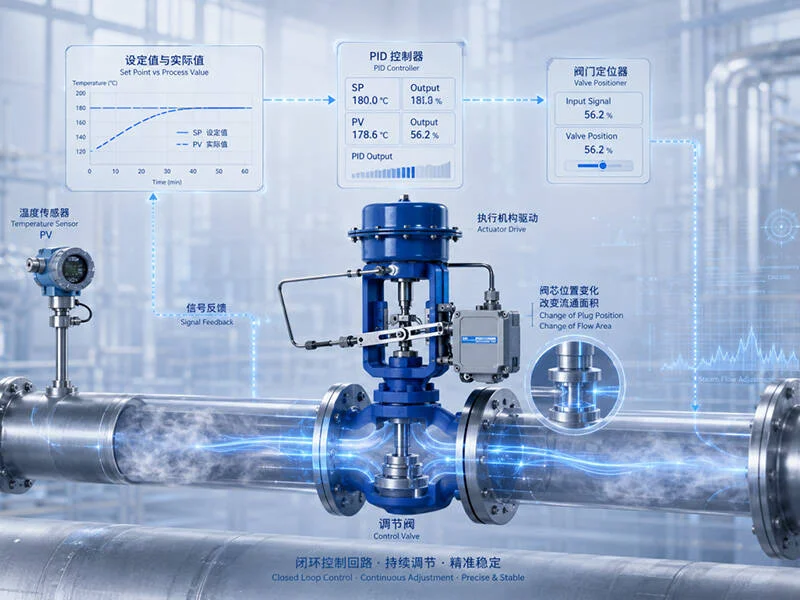
This control loop operates in a continuous cycle.
Consequently, the control valve does not merely toggle between “open” and “closed” states; it constantly makes minute adjustments to operational deviations, ensuring that actual process parameters remain as close as possible to the set standards. It is not that the valve is “restless” due to a malfunction, but rather that it is diligently performing its core function of precise regulation.
A stable steam system relies not on a single precise adjustment, but on thousands upon thousands of minute corrections.
03 Why Engineers Prioritize Stability Over Speed
During on-site service, we often hear users request that valves operate as quickly as possible, emphasizing rapid response. However, from the perspective of steam control engineering, this requirement is not ideal.
When regulating steam flow, operational stability is far more important than response speed.
If a control valve operates too quickly—especially when control system parameters are mismatched—issues such as frequent oscillation (hunting) and unstable cycling can occur, leading directly to persistent fluctuations in temperature and pressure.
In contrast, a professionally tuned control system adjusts smoothly in response to changes in production load, ensuring the equipment consistently operates under optimal conditions.
This is why, during the commissioning process, engineers do more than just optimize PID parameters; they also verify Cv sizing, check flow characteristics, and ensure the valve operates within the optimal control range of 20% to 80%.
These seemingly minor details directly determine the ultimate control performance. For manufacturers, the benchmark for excellent control is not how fast the valve moves, but how stably the system operates.
04 Even a minute deviation can impact the quality of the entire production line.
In many process industries, control valves do more than just regulate steam flow; they directly determine the quality of the finished product.
Application Scenarios
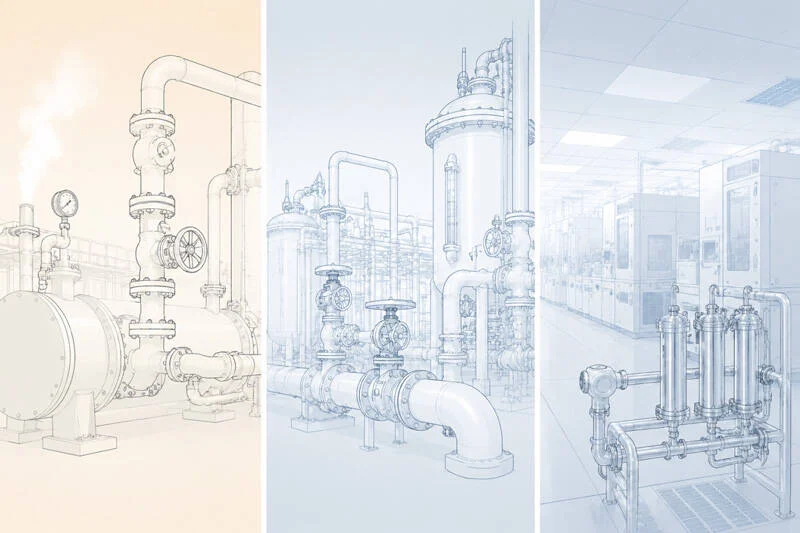
- In the food industry, fluctuations in temperature control can compromise sterilization effectiveness and the consistency of product taste.
- In the chemical industry, pressure drift can alter chemical reaction rates, leading to batch-to-batch product variations.
- In the pharmaceutical industry, deviations in heat transfer parameters can undermine process stability and trigger compliance risks.
05 True problem-solving goes far beyond the control valve itself
A very common scenario in the field involves users asking: “The control performance is getting worse—is it time to replace the valve?”
Experienced engineers would never rush to replace the equipment immediately.
Instead, we prioritize checking the stability of the boiler’s steam supply, whether the steam contains condensate, and the operational status of the condensate drainage system. We then verify the control loop, positioner feedback, the suitability of the Cv sizing, and the quality of the on-site installation.
This is because the control valve is merely the final actuating component of the steam control system; if steam quality is substandard or control strategies are poorly configured, even a high-end valve cannot deliver the desired control performance.
Effective steam management relies not on a single piece of equipment operating in isolation, but on the coordinated operation of the entire system.
This is the fundamental reason why an increasing number of enterprises are shifting from “component replacement” to “system-wide optimization.”
While many define the core function of a control valve simply as flow control, our extensive engineering experience leads us to view it as a vital bridge connecting the process system with the automated control system.
On one side, it executes the precise calculations of the controller; on the other, it responds dynamically to real-time fluctuations in temperature, pressure, and flow. Every minute adjustment to the valve position ultimately impacts product quality, energy efficiency, and overall production productivity.
That is why, at Newton, our focus extends beyond the control valve itself to its actual performance in managing the entire steam and thermal energy system.
After all, precise control is about far more than just flow; it encompasses every step of the production process, every unit of energy consumed, and the long-term, stable, and efficient operation of the customer’s production line.